
If you’re building a software startup in 2026, you might already know that users are increasingly asking AI for recommendations before they ever type a query into Google.
The commercial implications are already measurable. Billions in revenue are already being generated through AI referrals. Similarly, AI Overviews – Google’s own AI-generated summaries – began appearing for commercial queries at nearly double the rate by late 2025, rising from 8% to 18% of commercial search results according to Search Engine Land.
For a software startup trying to get noticed, the question is no longer just how to rank on Google. It’s how to get your SaaS product recommended by AI – and those are two different problems.
Aren’t AI results just Google results repackaged?
There’s a lot of debate on this topic, and I’ve seen arguments from both sides. Some SEO specialists keep arguing that generative AI still largely relies on search rankings, whether it’s Google, Bing, or Brave.
And on the surface, that seems to be true – many of the top-ranking brands on Google also get recommended by ChatGPT. However, I’d argue this isn’t the result of AI repackaging Google rankings – it’s just coming to similar conclusions based on different methods.
Crucially, some brands with strong search visibility are invisible to AI. Others with weak search rankings appear frequently in AI answers.
Additionally, a brand that ranks first on Google for a certain keyword may never appear in an AI-generated recommendation, while a product mentioned consistently across third-party editorial sources may surface repeatedly even if its own website has modest organic traffic.
To understand what’s causing this gap, we need to look into the specifics of how AI decides which products or services to recommend.
Continue reading: How ChatGPT Decides Which Businesses to Recommend
How we studied this
| Field | Details |
|---|---|
| Engines used | ChatGPT 5.3 · Gemini 2.5 Pro · Claude Sonnet 4.6 · Google search |
| Subcategories researched | Recruiting software · Sales software · Customer support software · Email marketing software · AI meeting assistant software |
| Research date | March 2026 |
| Example prompts |
|---|
| “best customer support SaaS for fast response times” |
| “best email marketing SaaS for automation and AI” |
| “best AI meeting assistant SaaS with integrations” |
We didn’t want to rely on theory and external sources alone. So we ran a structured internal study to understand what actually drives SaaS product AI visibility across real recommendation engines.
Our methodology was straightforward. We crafted 25 customer-intent prompts – the kind of questions a real buyer would ask when evaluating software. We ran each prompt across three AI engines: ChatGPT (5.3), Gemini (2.5 Pro), and Claude (Sonnet 4.6), all from a US IP with web search enabled.
We tested five SaaS categories: recruiting software, sales software, customer support software, email marketing software, and AI meeting assistant software.
We then compared which brands appeared in AI responses against their organic search visibility patterns, looking for where the two aligned – and where they diverged.
Of course, this wasn’t an exhaustive academic study – we didn’t monitor thousands of prompts across different geographies and different times.
We chose this approach because it’s similar to how we research our clients’ AI visibility footprint – with manual searches of high-value purchase intent prompts. We found this to be more indicative of actual AI referrals than using broader and more sophisticated tools like Semrush, as we feel it’s closer to what the average AI user will see during researching providers.
With that being said, our findings were largely in line with more extensive studies and provided several key insights that those studies missed. Below are our top five learnings from researching how AI tools like ChatGPT, Gemini, and Claude decide with SaaS companies to recommend.
Top 5 learnings: GEO for SaaS Companies
1. Search visibility and AI visibility are different games
Confirming our intro to AI vs. Google: the clearest finding from our study was that ranking well in Google doesn’t necessarily predict whether AI systems will recommend your product.
We observed brands with strong organic search positions that were entirely absent from AI-generated recommendations, and conversely, products with modest search traffic that appeared consistently across ChatGPT, Gemini, and Claude.
This gap isn’t unique to our data. An Ahrefs study on AI Overviews found that the sources Google’s own AI features cite frequently differ from the pages that rank highest in traditional organic results.
The implication is clear: the signals that earn a top-ten Google ranking – backlink authority, on-page optimisation, technical performance – are helpful, perhaps even necessary, but certainly not sufficient for AI inclusion.
In our recruiting software category, for example, products that dominated the first page of Google for high-volume keywords didn’t reliably appear when we asked AI engines “what is the best recruiting software?” The AI responses drew from a different evidence base – one shaped more by editorial breadth than by any single ranking factor.
For startups, this means treating SEO and AI visibility as related but distinct workstreams. Winning one doesn’t guarantee winning the other, and neglecting either leaves a growing gap in your buyer’s discovery journey.
2. Repeated editorial presence is the strongest correlated signal
Across all five categories we tested, the brands that appeared most consistently in AI recommendations shared one characteristic: they were mentioned across a high number of independent third-party listicles, review articles, and editorial roundups.
This pattern aligns with how large language models collect and evaluate information. Rather than relying on a single authoritative source, AI systems appear to weight corroborated multi-source mentions.
If your product appears on one “best of” list, that registers. If it appears across a dozen, published by different outlets, that seems to cross a confidence threshold where models treat the recommendation as reliable enough to surface.
The practical consequence is that distributed editorial presence functions as a trust signal for AI – much the way backlinks function as a trust signal for Google, but operating through a different mechanism. Bain’s research on generative AI and search notes that AI systems are fundamentally changing how brands earn visibility, shifting from keyword-driven discovery toward recommendation-driven discovery where the volume of mentions matters.
For startups, this reframes content strategy. The goal isn’t to produce one definitive piece of content and rank it. It’s to earn inclusion across many pieces of content produced by others – a fundamentally different investment that requires sustained editorial outreach.
3. Well-known products disappear when intent positioning is weak
Brand recognition alone doesn’t guarantee AI inclusion. For example, BambooHR, one of the most widely used HR and recruiting platforms, didn’t appear at all in our prompts asking for the best recruiting SaaS.
The likely explanation is positioning specificity. BambooHR’s public-facing content positions it as a broad HR platform rather than narrowly as recruiting software. When a buyer asks an AI system for “the best recruiting software,” the model looks for products explicitly and repeatedly described in those exact terms across third-party sources.
A product positioned as “HR software that also does recruiting” may not match the intent pattern as strongly as one positioned squarely as “recruiting software.”
This observation held beyond the recruiting category. In several cases, established products with high brand awareness were absent from AI responses because their editorial footprint described them in general terms rather than aligning with the specific buyer intent our prompts targeted.
The takeaway is that companies should audit how their product is described not just on their own site, but across every third-party mention. If the language doesn’t match the queries buyers actually ask, you’re invisible to AI, regardless of how well-known your brand is.
4. Media density creates more stable results
Not all categories behave the same way in AI recommendations. We found that categories with heavy editorial and listicle coverage – like email marketing software – produced remarkably stable AI results across engines and repeated queries.
The same five to seven brands appeared consistently. Categories with thinner editorial ecosystems showed significantly more volatility, with different products surfacing each time.
This pattern suggests that editorial density creates a kind of consensus that AI systems anchor to. When dozens of independent publications converge on a similar set of recommended products, models have a strong signal to draw from. When few authoritative editorial sources exist, the model’s confidence is lower, and outputs become more variable.
SparkToro’s research on zero-click search highlights a related dynamic: as search engines and AI systems increasingly answer queries directly, the editorial layer that sits between a brand and the buyer becomes more important, not less. The publications that AI systems draw from are effectively the new gatekeepers.
For SaaS startups evaluating where to invest, this has strategic implications. In editorially dense categories, breaking into AI recommendations requires crossing a high threshold of editorial mentions – what we describe below as the editorial tax.
In thinner categories, a smaller number of well-placed mentions may be enough to establish consistent AI visibility, making those niches potentially higher-ROI targets for new entrants.
5. Understanding the editorial tax is key
The editorial tax is the minimum volume of independent third-party mentions a product needs to accumulate before AI systems treat it as recommendation-worthy.
In our email marketing category, for example, the products that appeared in AI recommendations were the same ones that showed up across the highest number of third-party comparison articles. Products outside that editorial footprint were effectively invisible.
This dynamic is self-reinforcing. Products that already appear in many listicles are more likely to be recommended by AI, which drives more attention, which leads to inclusion in more listicles. For new entrants, the cost of breaking this cycle is real and should be planned for – it requires deliberate, sustained investment in editorial outreach.
The practical response for startups in crowded categories is to budget for editorial presence as a core acquisition channel rather than treating it as an afterthought.
Or alternatively, find a subniche with a lower editorial tax (e.g., by specializing in certain geographies, target customers, or features). In less crowded verticals, the editorial tax is lower, and a focused campaign of five to ten well-placed mentions can shift your AI visibility meaningfully.
5 steps SaaS companies should take
If you’re looking to take immediate action, below are five steps you should be doing right to improve your SaaS company’s favour with the AI gods.
Step 1: Audit your current AI visibility
Before building any strategy, you need to know where you stand. Run 10–15 customer-intent prompts relevant to your category across ChatGPT, Gemini, and Claude. These should mirror what real buyers ask – questions like “what’s the best recruiting software for a 50-person company?” or “which email marketing tool works best for early-stage startups?” Note where your brand appears, where competitors appear, and where you’re absent entirely.
Pay close attention to the gap between your search rankings and your AI presence. Our study found that strong Google visibility doesn’t predict AI inclusion. You may rank on page one for your target keywords and still be invisible to every major AI engine. Conversely, a competitor with weaker organic traffic might appear in every AI recommendation because their editorial footprint is broader.
Document which sources AI engines cite when they mention competitors. These citations reveal the publications and content types that each model trusts. This source map becomes your outreach target list in Step 3.
This isn’t a one-time exercise. AI outputs shift as models update and new content enters training data. Run this audit quarterly at minimum, tracking changes over time to measure whether your efforts are moving the needle.
Step 2: Build entity-clear, self-contained content
AI systems don’t read your website the way a human visitor does. They extract fragments – a paragraph here, a sentence there – and synthesise them into recommendations. If any individual fragment requires surrounding context to make sense, it’s less likely to be selected.
Every key paragraph on your product pages, comparison pages, and editorial content should clearly communicate what your product is, what category it belongs to, who it serves, and how it differs.
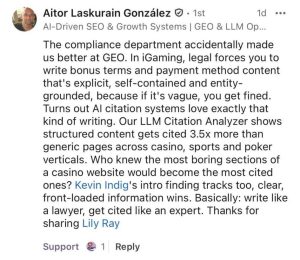
As SEO specialist Aitor Laskurain González reported on LinkedIn, explicit, self-contained, entity-grounded writing appears to be cited more often by AI systems. This aligns directly with what we found in our study.
Brands with vague positioning – calling themselves “the intelligent platform for modern teams” instead of “recruiting software” – were consistently absent from AI recommendations, even when they had strong brand recognition.
In practical terms, this means rewriting your core pages with deliberate redundancy. Your homepage, your feature pages, and your about page should each independently establish your category, your target customer, and your key differentiators. don’t assume the reader – or the AI model – has seen any other page on your site.
Use schema markup to reinforce entity clarity at the code level. Structured data gives AI retrieval systems an unambiguous signal about what your product is and how it relates to its category.
Combined with well-written content, this creates a double layer of clarity that makes it significantly easier for AI systems to categorise and recommend you.
Step 3: Earn Organic Editorial Coverage
This is the highest-leverage activity for getting your tech startup recommended by AI. Start by mapping the publications AI engines already cite in your category. Run your audit prompts from Step 1, note the sources referenced in AI responses, and focus your outreach on those specific publications.
Build this presence systematically over months, not in a single push. Pursue guest contributions, product reviews, expert roundups, and directory inclusions in parallel. Each new mention compounds your visibility.
The goal is depth and repetition – enough independent editorial corroboration that AI systems become confident recommending you.
Before kicking off with a strategy, be sure to understand your industry’s editorial tax, or in other words, try to gauge how many placements you will need to break through the AI barrier of entry.
Step 4: Cover your category comprehensively on-site
As many SEO specialists have already noted, AI models appear to use fan-out, site-style querying patterns – or in simple terms, they assess the depth of a site’s content on a topic, not just individual pages.
Holy smokes SEOs, the GPT 5.4 is using “site:” search A TON.
This is going to dramatically increase the importance of on-site content that connect with fan-out queries. pic.twitter.com/K0mrzrJ91E
— Chris Long (@chris_nectiv) March 16, 2026
A SaaS startup with a homepage and a pricing page is far less likely to register with AI systems than one with comprehensive topical coverage across its entire category.
Build out content that addresses your category from every angle a buyer might explore: use cases by company size, feature comparisons with named alternatives, integration guides for popular tools in your stack, implementation timelines, and pricing context.
Each of these pages creates an additional surface for AI systems to discover and extract information about your product.
This is where your SEO strategy and AI visibility strategy overlap most directly. The same comprehensive content that helps you rank for long-tail search queries also builds the topical authority that AI models evaluate when deciding whether to recommend you.
The difference is that for AI, the content needs to be self-contained and entity-clear at the paragraph level, not just optimised for a target keyword.
don’t neglect comparison and alternatives pages. When a user asks an AI engine “what are the best alternatives to X?” the models look for content that explicitly addresses that question. If you have a well-structured page comparing your product to key competitors, you dramatically increase your chances of appearing in those responses.
Step 5: Maintain explicit category and use-case positioning
Every piece of public-facing content – your website, your guest posts, your directory listings, your social profiles – should clearly and repeatedly state what your product is, what category it belongs to, and what specific problems it solves.
Our research found that well-known products disappeared from AI recommendations when their positioning didn’t clearly match the intent of the prompt.
Use the exact language your buyers use. If your customers search for “sales engagement platform,” don’t describe yourself only as a “revenue acceleration solution.”
Run your audit prompts to see what language AI engines use when describing your category, and mirror that language across your content. The same should be done with all your external sources as well.
Review your positioning quarterly as part of your AI visibility audit. Categories evolve, buyer language shifts, and new use cases emerge – now faster than ever. The startups that maintain tight alignment between their positioning and the way buyers actually ask questions will hold their AI visibility advantage over time.
What small and new brands should do differently
If you’re a new startup with limited resources and no existing editorial footprint, the five steps above still apply – but the sequencing and emphasis should shift.
Start with entity clarity. Before you pursue any external coverage, make sure your own site unambiguously communicates what you’re.
If budget is an issue, it’s absolutely crucial to find a (sub)niche with a low editorial tax. Focus on niche specificity rather than broad category coverage.
Continue reading: What is the editorial tax (and what does it mean for GEO)?
A new brand trying to appear in AI answers for “best CRM software” will struggle against entrenched competitors with years of editorial presence. But a new brand positioning itself for a specific sub-niche – “best CRM for independent insurance agencies,” for example – has a realistic path.
AI systems respond well to specificity because it reduces ambiguity. If you’re the only product consistently described in relation to a narrow use case across a handful of sources, you have a genuine chance of appearing in AI recommendations for that query.
Build your editorial presence methodically. Prioritise getting included in niche-specific directories, industry publications, and vertical review sites before pursuing broad-market listicles. The editorial tax in broad categories is steep for new entrants. In narrow verticals, a few well-placed mentions can be enough.
Continue reading: 5 Steps to Build External Validation for AI Recommendations
Finally, invest in original research or proprietary data early. According to Yotpo, content with unique statistics or original research functions as a kind of “citation worthiness” signal in the zero-click economy.
For a new brand, publishing a credible industry survey or data report can create the kind of citable asset that earns mentions from other publications – accelerating your editorial presence and AI visibility simultaneously.
